Why Satire Isn’t an Attack: SNL, Aimee Lou Wood, and the Confusion Between Parody and Personal Offense
Recently, Saturday Night Live ignited a firestorm with their sketch “The White Potus,” a parody blending The White Lotus Season 3 aesthetic with political figures from the current administration. But what really blew up wasn’t the politics—it was a portrayal of actress Aimee Lou Wood’s character from The White Lotus. Or rather, the parody of that character.
In the sketch, the only actual actor being directly mimicked was Wood. The rest were politicians. The SNL actress portraying her wore exaggerated prosthetic teeth—meant to resemble the real ones Wood proudly displays—and mimicked her strong regional accent. Her offensive line in the skit? “Oh no. Not the monkey!” That was it. No obscenities. No crudeness. Just a brief, light jab—one that would’ve gone largely unnoticed had it not been for the backlash.
After the episode aired, Aimee Lou Wood voiced her disappointment and offense at the skit. And this, right here, is where I find myself out of sync with a growing trend in today’s culture: the inability to separate oneself from the characters we play, or to understand that parody is not persecution.
Let me be clear—Aimee Lou Wood is a tremendous actress. She’s chosen not to fix her teeth in an industry that still (unfairly) values women by narrow beauty standards. That choice alone is powerful. It challenges norms. It inspires. But the moment she publicly took offense at the SNL parody, she diluted that power.
Because satire, by definition, pokes at characters. At exaggeration. It takes what we see on screen and amplifies it for humor or commentary. The SNL skit wasn’t mocking Aimee Lou as a person. It wasn’t dragging her private life, her beliefs, or her value as a woman. It was parodying the character she played. The woman with a thick accent, big teeth, and an odd fascination with monkeys. It’s what satire does. And to conflate that with a personal attack is to misunderstand the entire premise of comedy.
Are we now at the point where all caricature is cruelty? Is mimicry always mockery? If so, we’re heading toward a cultural dead end where art, humor, and even admiration get silenced out of fear someone might take it the wrong way.
No one is above parody. Not politicians. Not celebrities. Not even characters on a fictional luxury vacation. And when the line between actor and role gets blurred in our minds, we lose the ability to laugh at anything—especially ourselves.
So yes, the teeth were exaggerated. That’s what parody does. And if we’re going to claim power in being different, we have to be strong enough to let the world chuckle once in a while—especially when the joke isn’t even aimed directly at us.
Satire is not sin. Sometimes, it’s just a skit.
Where do you draw the line between funny and offensive? Leave a comment and join the conversation about satire, identity, and the evolving rules of public humor.
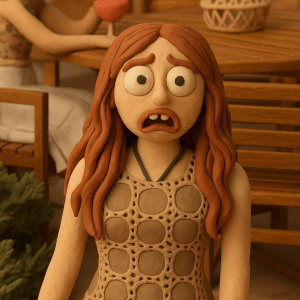
This AI-generated image depicts the character portrayed by Aimee Lou Wood on The White Lotus, not the actress herself. The AI declined to generate an image of Aimee Lou Wood as a real person, but it allowed the depiction of a fictional character from a television show—which is a key distinction. Yes, there is a difference.
Discover more from Tate Basildon
Subscribe to get the latest posts sent to your email.


 Tate Basildon