


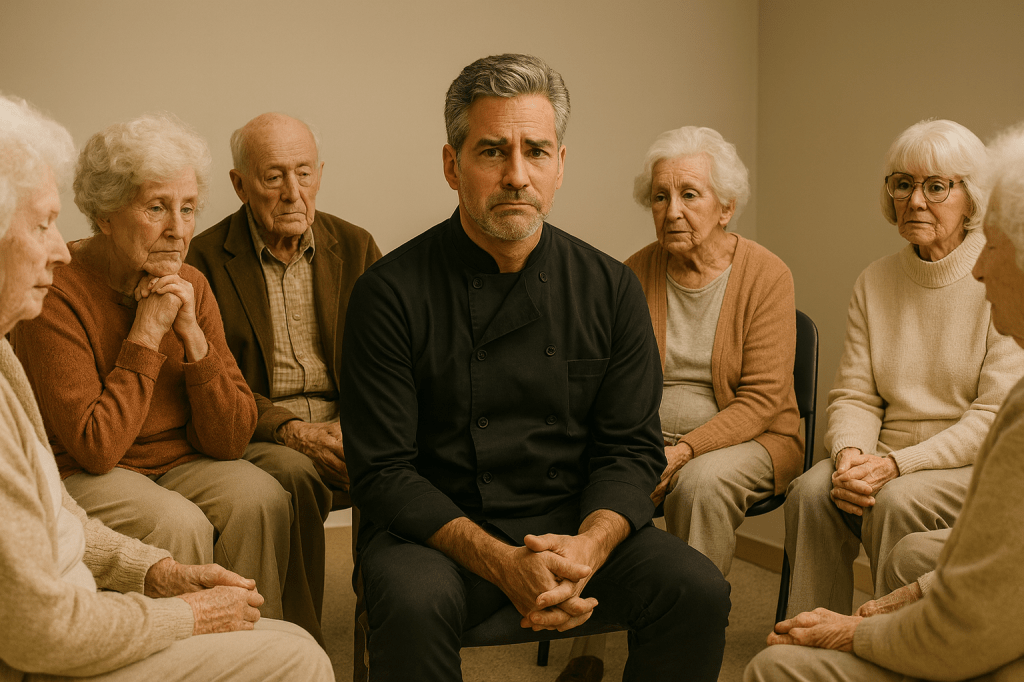
When I was first diagnosed with sarcoidosis all those years ago—back when I thought the biggest stress in my life was getting dinner on the table on time—I walked straight into a kind of emotional freefall. Cardiopulmonary sarcoidosis wasn’t something people my age were dealing with. Not in the real world, and definitely not in my social circles. At 45, strong, active, working full-time as a private chef, I went from “clean bill of health” to “your lungs and heart have formed an alliance against you” in the time it takes to season a chicken. And suddenly I was surrounded by people decades older than me, shuffling around hospital halls with oxygen tanks, while I still felt like I should be biking around the neighborhood or planning my next vacation.
It was isolating in a way I didn’t have the vocabulary for yet. Not sad, not scared—just…unmatched. Like I’d shown up to the wrong audition. And the casting director was God.
Everyone meant well, of course, but meaning well doesn’t magically make people relatable. And in the early 2010s, when my world had shrunk to a mess of tests, pulmonary hypertension scares (the kind that, thankfully, later reversed on their own), and heart failure complications, I kept getting told: “You should try a support group.” So I did. Because when you’re newly diagnosed, you cling to every lifeline—even the soggy, unraveling ones.
The Mt. Sinai group in New York City sounded promising on paper. A reputable hospital. A safe environment. Other humans with questionable lungs. What could go wrong?
Well.
First, there was the commute. An hour-long train ride where I’d sit trying not to look like the guy silently negotiating with his own oxygen intake. Then a taxi—or a kamikaze-style drive through Manhattan traffic where I’d arrive already out of breath because inhaling exhaust fumes apparently counts as cardio. Parking near the hospital? Ha. If you didn’t sacrifice a goat to the Parking Gods beforehand, forget it. I’d end up blocks away, wheezing my way past people speed-walking like they were being chased.
Then came the actual meetings.
The first one was around Christmas. You’d think “holiday spirit” would soften the blow, but no—this was arts-and-crafts hour with zero sense of irony. Everyone there already knew each other, chatting away like they were at a brunch I wasn’t invited to. They made ornaments, exchanged gossip, and threw in a sprinkle of polite pity when they looked in my direction. It wasn’t unkind. It just wasn’t…anything I needed. I wanted connection about illness, survival, fear, hope—something real. Instead, I got glitter glue.
The second meeting was somehow worse. It turned into an emotional black hole where every person took a turn complaining about their husbands, their children, their grandkids, their neighbors, and possibly their mailman. Everything except the illness we were supposedly there to talk about. I left feeling heavier than when I walked in—and considering the state of my lungs at the time, that’s saying something.
So I stopped going. Not dramatically. No “It’s not you, it’s me” speech. I just realized I wasn’t going to find my people in a hospital basement with a folding table centerpiece and stale coffee.
Instead, I did the thing that saved me: I started a blog.
Back then, blogging felt like opening a window in a sealed room. I wasn’t guaranteed anyone would read it, but for the first time, I could speak—and someone, somewhere, could speak back. Maybe someone younger. Maybe someone newly diagnosed. Maybe someone who, like me, didn’t want pity, but perspective. Someone who wanted to feel less alone at 2 a.m. when the chest tightness felt like a small elephant with boundary issues.
Nearly two decades later, after surviving things that truly should have taken me out—lungs collapsing, heart failure, long-term oxygen therapy, an ICD, prednisone turning my bones into chalk, that persistent little PFO leak—I’ve learned to live with sarcoidosis like it’s an obnoxious roommate. Some days it behaves. Some days it eats my snacks and refuses to pay rent. But I know its patterns now, even when it tries to surprise me.
Support groups didn’t help me, but that doesn’t mean they’re useless. For many people, they’re a lifeline. A place to cry, complain, connect, breathe, share, or just not feel weird or broken for an hour. There’s beauty in that. There’s community in that. And I genuinely love that some folks find comfort there.
But I’ve always been fiercely independent. Blame my upbringing. Blame stubbornness. Blame the fact that I once tried to power through a collapsed lung like it was seasonal allergies. Group therapy was never going to be my vibe. Writing, however—sharing my story, my fears, my sarcastic commentary on this circus of chronic illness—that connected me in a way a circle of folding chairs never could.
So now I’m curious:
Are you part of a support group? Did it help you, frustrate you, save you, drain you, or maybe surprise you in ways I couldn’t imagine? I’d love to hear how it worked—or didn’t work—for you.
Drop your thoughts below or hit subscribe so we can keep navigating this ridiculous, beautiful chronic-illness life together.
Discover more from Tate Basildon
Subscribe to get the latest posts sent to your email.
 Tate Basildon