


When my parents got engaged, neither of them were exactly card-carrying members of any church. But they both had religious conditions. My mother, who had abandoned one faith in her youth and then dabbled in something else before settling on Presbyterianism, insisted on a Presbyterian wedding. My father—raised Catholic and stubborn to his bones—agreed, but only if the children would be raised Catholic.
So that’s what they did. And because of that, part of my father’s family refused to show up to the wedding. Some cousins barely acknowledged us growing up, because in their eyes we were illegitimate little heathens. Bastards, if you want the blunt version. Family, right?
Anyway, off I went to Catholic school from age five to sixteen. At first, I was all in. I drank the Kool-Aid, read the Bible cover to cover (yes, Old and New Testament—don’t ask how a teenage boy stuck with that), and even considered myself devout. But eventually, the cracks showed. Like many kids churned through Catholic school, I walked away not with faith, but with a deep sense of ugh, never again.
And nothing fueled that more than confession.
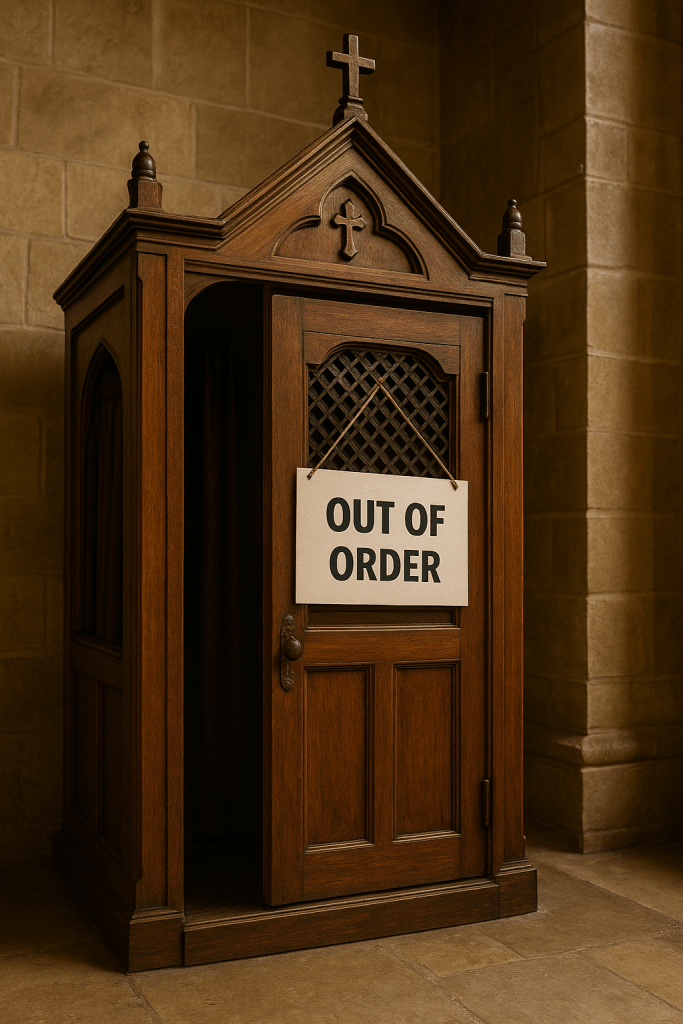
If you’ve never been Catholic: before you can receive communion, you’re supposed to confess your sins. Picture a booth, a screen, and a priest who “doesn’t know who you are.” (Except—spoiler alert—he totally does, because you go to his school.) You whisper your wrongdoings, he assigns a few prayers, and voilà—clean slate! The cosmic reset button.
Sounds harmless, right? Except people took it way too literally.
I watched classmates commit some truly awful nonsense, then stroll into confession, mumble their lines, and walk out believing they’d been absolved. Like “thank you, Father, for forgiving me for being a total jerk all week. See you next Wednesday!” It wasn’t faith—it was a permission slip.
Fast forward to my first job out of school, at a bank. One of the accountants there was a self-proclaimed “good Catholic.” She gossiped nonstop, cursed out coworkers, and detailed her sex life with her husband in ways that made me want to bleach my ears. But every Wednesday she’d grin and say, “It’s fine—I confessed. I’m clean again.”
I couldn’t take it anymore. One day I asked her: “If you’re such a good Catholic, why do you talk about everyone like that?”
Her answer? “I go to confession every Wednesday. I get to start fresh.”
That right there sealed the deal for me.
Confession wasn’t designed to be a weekly rinse cycle so you could keep being a terrible person. But that’s how she—and too many others—used it. And at sixteen, I decided I was done. I haven’t been to confession since.
Do I consider myself spiritual? Absolutely. But I don’t believe in loopholes, resets, or cosmic Get-Out-of-Jail-Free cards. My belief system now is painfully simple: just try to be a good human all the time. Not perfect, not saintly—just decent. And you shouldn’t need a booth, a priest, or a prayer penalty to remind you of that.
So maybe that’s my confession: I don’t buy confession.
What about you—did religion shape you, scar you, or both? Have you ever wrestled with the idea of confession, forgiveness, or just trying to be a decent human without a reset button? Drop your thoughts in the comments, or subscribe if you want more messy, honest stories from a chef-turned-novelist navigating chronic illness, faith, and life.
Discover more from Tate Basildon
Subscribe to get the latest posts sent to your email.
 Tate Basildon
I’m not catholic. I don’t go to church but I’ve listened to a few sermons online and I went to church as a child. I’ve always thought the confessional was a way to unburden your soul so you wouldn’t have to lie to God or yourself. Then, you would try to be a better person from there. Right?
LikeLiked by 1 person
That is exactly what it supposed to be. You confess, and gain the strength not to repeat the sins. But people think of it as a reset to go “sin” again until the next reset.
LikeLike