


You can listen to this episode on my podcast here
I swear, every time I think I’ve seen the full circus of modern healthcare, someone pulls a fresh clown out of the MRI machine. I have an MRI scheduled next week, which already means mentally preparing for the usual choreography: the oxygen tubing, the ICD protocols, the dramatic pause at the part where someone inevitably asks if my heart device is “the exploding kind.” (It’s not, but thank you for the concern.) So when the hospital sent me a link to “check in online,” I figured, great—less paperwork to juggle while I sweat through the hospital gown designed by someone who clearly hates people with chronic illness and a sense of dignity.
I clicked the link expecting the standard questions: medications, emergency contact, medical devices, whether my ICD will decide the MRI is an existential threat and go rogue. And for a while, that’s exactly what I got. They wanted every detail about my device—brand, model, serial number, probably the favorite color it would choose if given the option. I answered everything because, you know, I would also like to survive the MRI.
But then I got to the last section.
And the last section… had vibes.
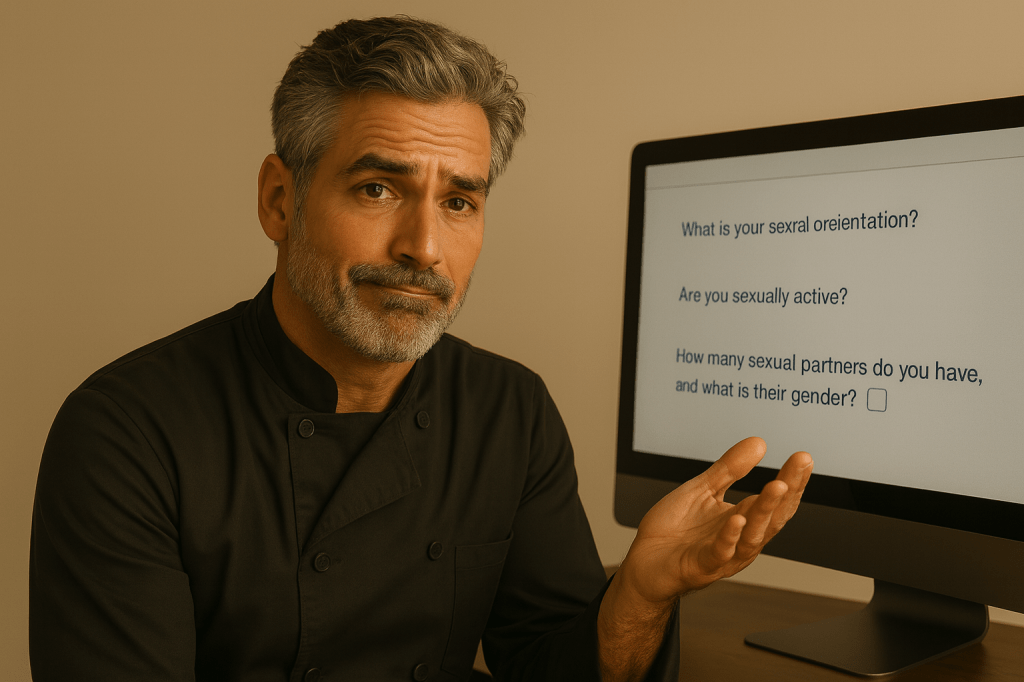
Three questions glared back at me like they were waiting to be invited in for a cup of tea and my deepest secrets:
1. What is your sexual orientation?
2. Are you sexually active?
3. How many sexual partners do you have, and what is their gender?
I stared at my screen so hard I’m pretty sure it needed a medical device check. My heart (the one with the AICD, courtesy of sarcoidosis and heart failure) skipped a beat—not in a romantic way, but in a “why the hell is this happening before an MRI?” way.
I sat there thinking, Did the MRI suddenly get freaky? Is it planning a date? Am I supposed to swipe right on the imaging machine before it slides me into the tube? Did someone at the hospital mix up my medical forms with a sex-positive TikTok survey?
Because let me be really clear: why would an MRI need to know who I sleep with? Or if I sleep with anyone at all? Or how often? Or what configuration?
It felt invasive. Gross. The kind of privacy violation that makes you want to shut your laptop and go rinse your soul in bleach.
Hospitals already know too much about me. They’ve seen my lungs collapse, my heart misbehave, my sarcoidosis flare like it’s auditioning for a Broadway revival, and my AICD scar that looks like a failed attempt at avant-garde embroidery. They already have my blood, my scans, my insurance, and—let’s be honest—my wallet. But now they want access to my intimate life, too?
And for what?
The MRI does not care if I’m straight, gay, bi, or spiritually aligned with my sofa. It doesn’t need to calculate how many sexual partners I have before it decides whether its magnets are strong enough today. This was not relevant. This was not appropriate. This was not even in the same universe as necessary.
This was a data grab.
A quiet, normalized one hiding inside a medical check-in form, hoping patients would just shrug and answer because “it’s healthcare, so it must be important.” Except no. Not today, Satan. Not today.
Medical privacy is supposed to be about protecting patients—not turning our intimate lives into optional-but-not-really-optional metadata for someone’s demographic spreadsheet. When those questions have nothing to do with my ICD safety, or my MRI protocol, or any part of my actual care, it stops being healthcare and starts being surveillance. And people with chronic illnesses—already vulnerable, already exhausted, already navigating more red tape than a crime scene—shouldn’t have to fend off intrusive questions when we’re just trying to get a damn scan done.
So under “Other,” for all three questions, I wrote exactly what my fed-up, oxygen-tubed, chronically ill chef self was feeling:
“None of your fucking business.”
And I meant it with the fullness of my heart, leaks and all.
We deserve privacy. We deserve boundaries. We deserve medical systems that treat us like people—not data points to be mined. So if you’ve ever felt violated by a form, blindsided by a question, or pressured into revealing something that wasn’t medically relevant, trust me—I’m right there with you, shouting into the void and waiting for the MRI machine to mind its own business.
If you’ve had a similar experience or want to weigh in on this growing issue of medical privacy, drop a comment below—or hit subscribe so we can keep unpacking these absurdities together.
Discover more from Tate Basildon
Subscribe to get the latest posts sent to your email.
 Tate Basildon