

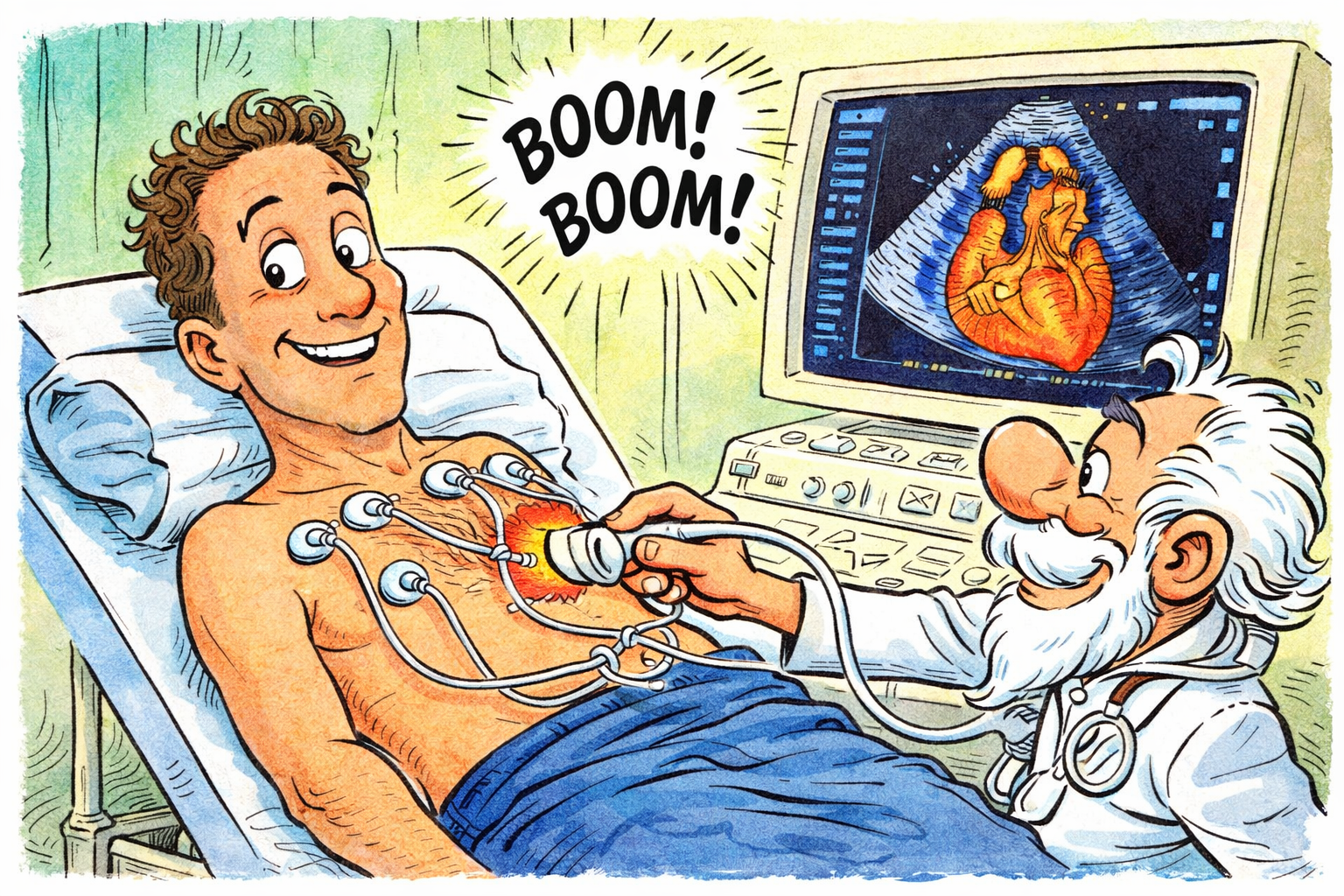
Yesterday I had my exercise stress test, which is basically the one appointment where I voluntarily climb onto a treadmill to be judged by medical machinery, a room full of professionals, and my own lungs—who always act like they’ve been personally offended by the invitation.
I never look forward to it. There is nothing glamorous about being strapped up with electrodes like a budget sci-fi extra and then told to “just walk normally” while your body does everything except walk normally. It’s a live performance of Wheeze: The Musical, and I am always the star.
But I was oddly glad to do it.
When you’re living with heart failure from cardiac sarcoidosis, you become the kind of person who treats “not getting worse” like a standing ovation. Improvement feels like spotting a unicorn in the parking lot of a cardiology clinic. You don’t expect it. You don’t count on it. You definitely don’t announce it until you’ve confirmed you’re not hallucinating from low oxygen.
And people have been warning me for years not to expect improvement. Not casually. Not gently. Repeatedly. With conviction. Sarcoidosis, they said, isn’t known for handing out miracles. Heart function goes down, not up. Decline is the rule, not the suggestion. I get it. Cardiac sarcoidosis can leave scarring and inflammation behind like it’s redecorating your heart in permanent damage.
The week after I got my defibrillator placed, my heart failure specialist started floating the idea of a transplant the way a chef might recommend a new restaurant: “Oh, you should try it sometime.” Sir. I am still learning where the batteries are in this device you just installed in my chest, and you’re already talking about organ replacement like it’s a seasonal menu change.
I told him I believed my heart would get better.
He gave me that smile doctors reserve for patients who are either wildly optimistic or delightfully delusional—the smile that says, “That’s adorable,” without using words, because if they use words, they have to chart them.
Back then, my ejection fraction sat below 25%. If you don’t speak cardiology, ejection fraction is the measurement of how much blood your heart pumps out with each beat. And under 25% is not “a little off.” It’s the cardiac equivalent of showing up to work and immediately putting your head down on the desk.
Below 25% is: “Your heart is phoning it in.”
A year later it crept up to 30%. Then 35% the year after that. And the entire team of specialists blinked at me like I’d just pulled a rabbit out of my chest.
Because sarcoid hearts don’t typically repair themselves. They don’t usually improve. They don’t bounce back like, “Sorry, I was just going through a phase.” That isn’t the usual storyline. That’s not what the textbooks promise. And yet there mine was, ignoring the syllabus.
So when I walked into yesterday’s test, I carried my normal mix of dread and hope—the kind you learn to carry when your life includes medications, appointments, and sentences that start with: “Let’s see what we find.”
First was the echo, the ultrasound of the heart. The technician was kind, professional, and clearly prepared for routine. She started the scan, watched the screen, frowned, adjusted, frowned harder, and then did the thing technicians do when something doesn’t make sense: she went quiet.
Not “quiet like peaceful.” Quiet like, “I’m doing math in my head and I don’t like the answer.”
Then she delivered a number that made both of us question reality: an ejection fraction of 57%.
Fifty. Seven.
For context, 55% to 70% is considered normal. Normal. As in: what you’d expect from a person whose heart isn’t out here freelancing and making cardiologists emotionally unstable.
She stared at the screen like it had personally lied to her. Shook her head. Muttersomething about it being “way too generous.” Then she manually tweaked the measurements the way a chef adjusts seasoning when a dish somehow tastes too good to be true.
The computer—now less enthusiastic but still impressed—spit out a resting EF of 45%.
Still good. Still not what anyone expects from a heart that’s been through cardiac sarcoidosis, heart failure, and the indignity of being fitted with an ICD.
Still absolutely worth the look on her face—the look of someone flipping back through your medical file like it might suddenly explain why this heart is out here breaking all the rules.
“Well, I’ll be,” she finally said. “Never saw that before.”
And I know what you’re thinking: should I be offended my heart is confusing professionals? No. I’m proud. Confuse them, baby. Keep them guessing. If we can’t have straightforward health, we can at least have novelty.
Then came the exercise portion, better known as “the part of the test that proves why I avoid stairs.”
They hook you up, start the treadmill, and slowly increase the intensity. The goal is to push your heart and see what it does under exertion. Which, if you’ve met my body, is like saying, “Let’s poke this bear and see if it’s friendly.”
I walked. I breathed. I tried to look like someone who casually jogs for fun and does not treat the produce aisle like a cardio event. My heart rate climbed to 147. The room watched. The machine recorded. I did my best impression of “I am fine, yes, I definitely do this all the time,” while my lungs quietly organized a protest.
And then the first bad news arrived.
My oxygen saturation took a cliff dive to 75%.
Seventy-five.
That is not “a little low.” That is “why does the room suddenly feel far away?” low. That is “your body is politely suggesting you stop pretending you’re an athlete” low.
I wasn’t breathing so much as performing an interpretive dance titled Drowning on Land.
They rushed me onto the table for the second echo, and there I was—panting, glowing like an overheated toaster, trying to hold still while someone pressed a probe into my ribs and asked me to breathe normally.
Breathe normally. Sure. Let me just reach into my pocket and pull out a fresh set of lungs.
The doctor checked for pulmonary hypertension. None.
A genuine win.
So there we were, celebrating the small victory of “no pulmonary hypertension,” while also staring down the very obvious reality that my oxygen levels had tanked like they were trying to join a submarine crew.
And then, because life loves balance, the next piece of news arrived wearing trouble like a badge.
The stress echo showed that under exertion my heart stops beating properly.
Not “slightly off.” Not “a little quirky.” More like: it behaves fine at rest—calm, composed, even charming—and then the second it’s asked to do cardio, it turns into a disgruntled employee who clocks out without telling anyone.
At rest, my heart is like, “We’re good.”
Under stress, my heart is like, “Absolutely not.”
The room shifted into that familiar mode medical teams have when something is wrong but not neatly wrong. Not “Aha, here’s the answer.” More like, “Hmm. Interesting.” Which is doctor-speak for: we have theories and vibes, but nothing definitive.
Theories floated through the room like balloons you don’t want to grab because one of them might be filled with dread.
Maybe the scarring in my lungs is getting worse.
Maybe the lungs are stiffening.
Maybe the heart is simply tired of my optimism.
Maybe my body just enjoys dramatic timing.
No one had an answer stamped “definitive,” which is a familiar theme in sarcoidosis land. If sarcoidosis were a person, it would be that coworker who never responds to emails but always shows up with a new problem five minutes before you leave.
So now I’m off to my pulmonologist on Monday, because of course I am. There’s always a “next” appointment. There’s always another specialist. Another scan. Another test. Another hallway with fluorescent lighting that makes everyone look like they’re starring in a hospital documentary.
Last year, my sarcoidosis specialist gently floated the possibility of a lung transplant. Gently, like you might gently suggest someone consider switching from regular milk to oat milk. Very calm. Very casual. Meanwhile I’m sitting there thinking, “I’m sorry, what did you just say like it was a weather update?”
I tucked that information into the mental drawer labeled Not Today, Satan.
I’m holding onto the hope that I’m still nowhere near that stage. I’m holding onto the hope that there’s some fixable explanation—something that can be treated, adjusted, managed. Because I’ve learned, the hard way, that hope is not naïve. It’s practical. It’s fuel. It’s how you show up to the next appointment when you’d rather pull a blanket over your head and pretend your organs are someone else’s problem.
And I’ll be honest: the whiplash of the day messed with me. That’s the part people don’t always see. It’s not just the results—it’s the emotional ping-pong.
One minute you’re hearing numbers you never expected to hear. Numbers that sound like possibility. Numbers that make you want to laugh, cry, and high-five the echo technician.
The next minute you’re watching your oxygen saturation fall through the floor and hearing that your heart, under stress, isn’t behaving like it should.
It’s hard to live inside that contradiction. It’s hard to hold “improvement” and “new concern” at the same time without your brain short-circuiting.
Living with chronic illness is basically living inside a suspense novel you didn’t sign up to star in. The plot changes without warning. The villain is invisible. The timeline is rude. And the sequel is always being written whether you asked for it or not.
Still, I will take the wins where I can get them.
I will take the fact that my resting heart numbers—however we slice them—look better than anyone predicted. I will take the absence of pulmonary hypertension. I will take the moment the technician looked at the screen like my heart had committed a small crime against medical expectations, because honestly, that felt like a tiny rebellion on my behalf.
And I will also take the truth that I’m tired. Not just physically. Spiritually tired. The kind of tired that comes from having to be brave on demand.
If you live with sarcoidosis or any chronic illness, you know what I mean. You can do everything right and still end up with another question mark. You can show up to an appointment hoping for clarity and leave with a fresh set of uncertainties wrapped in polite medical language.
But here’s the thing: I’m still here. My heart is still beating—sometimes rebelliously, sometimes reluctantly, sometimes like it’s trying to keep up with a life that demands a lot from it. I’m still cooking. Still loving my wife. Still trying to be present for my pets, who absolutely do not care what an ejection fraction is as long as the food bowl is filled on time.
I’m still trying to live like a whole person, not a walking chart.
So yes, I’m waiting—for Monday, for whatever my pulmonologist says, for the next steps, for that slow unfolding of information that never comes all at once. I’m waiting while also living. Because that’s the job with chronic illness: you wait, and you live, and you do your best not to let the waiting swallow everything else.
And if you’re reading this and you’re in that same in-between space—between tests and answers, between fear and hope—I see you. If you’ve ever had your body throw you a curveball, if you’ve ever walked into an appointment bracing for bad news and walked out with something you didn’t expect—good, bad, or downright bizarre—you’re not alone.
We are out here collecting plot twists like trading cards.
If you’ve ever had a medical test surprise you—whether it made you laugh, cry, or stare at the wall for an hour—tell me about it in the comments. I read them. I truly do. And if you want more real-life medical misadventures served with sarcasm, heart, and the occasional rebellious organ, subscribe so you don’t miss the next chapter.
Discover more from Tate Basildon
Subscribe to get the latest posts sent to your email.
 Tate Basildon