
I always assumed, if I ever had to end a relationship, it would be with an actual person. Someone who left dishes in the sink “to soak” for three days. Someone who said “we should totally get together soon” and then vanished like a ghost with an avoidant attachment style.
But no. My big breakup was with Oprah.
Which feels ridiculous to say out loud, because Oprah is not sitting by the phone wondering why I haven’t called. Oprah is not asking her best friend Gayle, “Do you think Tate still likes me?” Oprah is not crying into a pint of ice cream while journaling about abandonment wounds.
Oprah is fine.
And yet, I still went through the emotional stages of a breakup. Denial. Rationalizing. Bargaining. That one phase where you stalk their new life from a safe distance and whisper, “Who even are you anymore?” into the void. And finally, acceptance. The kind where you don’t hate them, but you also don’t want them in your house, on your TV, or in your algorithm.
The truth is, I used to be loyal. Like, embarrassing loyal.
From the time I was a baby chef in the early ’90s, burning casseroles and thinking “mise en place” was just a fancy way to say “panic-prep,” I watched The Oprah Winfrey Show like it was therapy that didn’t require co-pays. Oprah was the one steady thing that didn’t demand anything from me except attention and maybe the occasional ugly-cry. She was the comfort food of television: warm, familiar, and oddly convincing even when she served something you didn’t totally understand.
She was powerful but relatable. Opinionated but inquisitive. She could go from hard questions to soft compassion in the span of a commercial break. She could launch a book into the stratosphere, shift the national mood, and make you believe your life could change if you just organized your pantry and forgave your third-grade bully.
And I bought it. I bought all of it.
I taped her show back when VHS was still a thing. I upgraded to TIVO because I did not trust my schedule to interfere with my spiritual appointment television. If there had been a way to beam Oprah directly into my home kitchen through osmosis, I would have said “sign me up,” and then I probably would’ve tried to braise something inspirational in her honor.
Then real life showed up with a steel chair.
At some point in adulthood, the human body stops being a reliable coworker and becomes that unhinged colleague who “forgets” to do their job and then acts offended when you ask them why. My lungs, for example, decided they were going to act like they were auditioning for a medical documentary. The words came: sarcoidosis. And suddenly everything got louder and smaller at the same time.
If you live with chronic illness, you know the weird math of it. The world keeps asking you to perform normal life while your body runs a totally different operating system. You become fluent in medication names, side effects, and the special kind of exhaustion that sleep doesn’t touch. You learn that “fine” is not a state of being; it’s a social strategy.
So yes, I leaned on comfort where I could find it. And Oprah, for a while, was that comfort. Like Grandma Oprah tucking you in with a story and some emotional mashed potatoes.
It worked. For a while.
Then Oprah left us.
Not like “Oprah moved away and wrote us heartfelt letters” left. More like “Oprah bought an island, built a tower on it, and started broadcasting from space” left.
When she launched the Oprah Winfrey Network, part of me was genuinely excited. An entire channel devoted to living your best life? Sure. Bring on the inspirational programming. Bring on the emotional breakthroughs. Bring on the segments that make you believe you can heal your trauma, fix your relationships, and become the kind of person who owns matching storage containers.
For a hot minute, I was hopeful.
And then the vibe shifted.
It wasn’t just that the show ended. It was that the Oprah I trusted started to feel… different. Like the warmth got replaced by something shinier. Like empathy got repackaged and sold in a more expensive box. Like instead of “Let’s talk about what you’ve been through,” it became “Let’s talk about what you should purchase to become the version of yourself I approve of.”
And I know, I know. She’s a businesswoman. She built an empire. She doesn’t owe me anything. I’m not out here claiming Oprah should personally call me to check on my lung function.
But when you’re chronically ill, your tolerance for fake gets microscopic. You don’t have the energy for performance. You want honesty. You want people who can sit with reality without trying to upsell you a better one.
Which brings me to Deepak Chopra.
Once upon a time, I didn’t mind him. I even appreciated some of what he had to say. Back when I was hopeful enough to believe healing had a blueprint, his stuff could feel soothing. It was like listening to someone describe peace in a language you didn’t fully speak but wanted to learn. You nodded along. You took what helped. You ignored what sounded like it came from a fortune cookie on mushrooms.
But then Oprah and Deepak teamed up, and I swear to you, my whole nervous system made a noise.
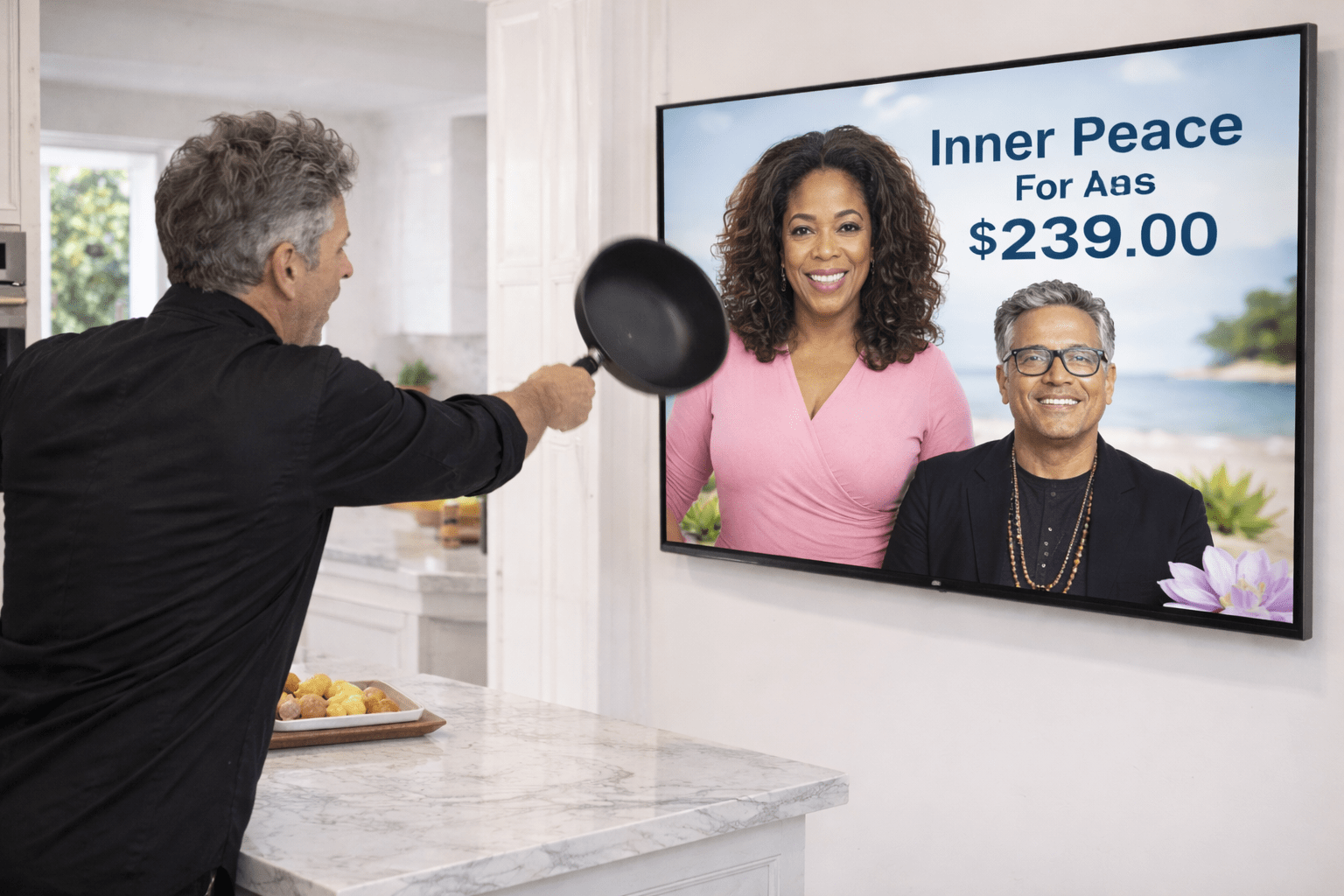
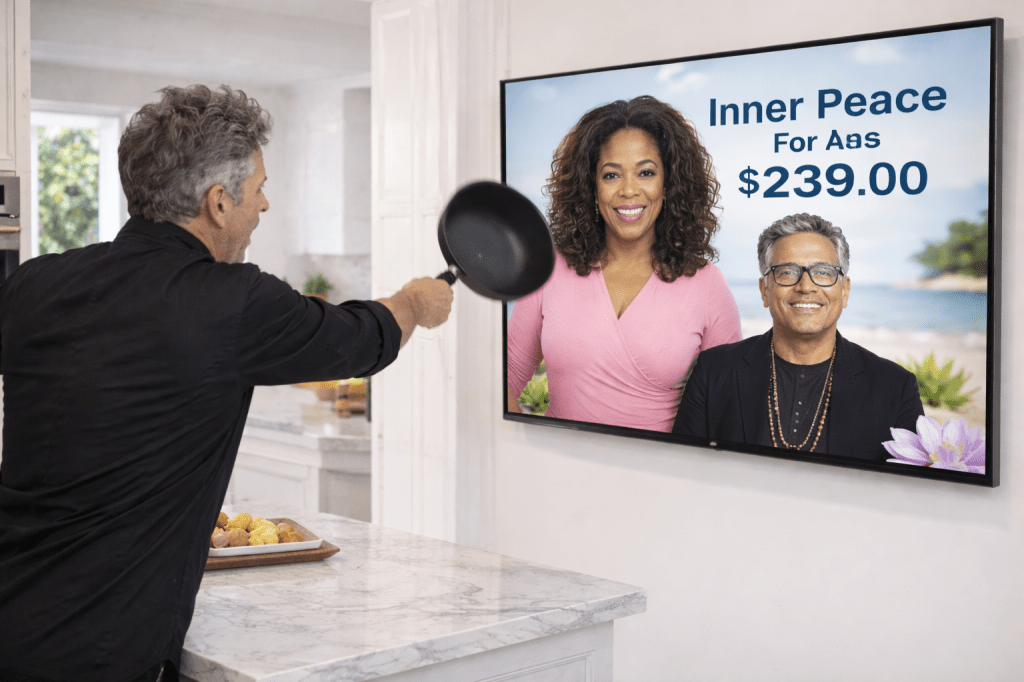
They launched meditation programs and apps and offerings that looked, from my angle, less like “here’s a tool that might help you breathe through suffering” and more like “here’s platinum-tier access to enlightenment, for a small monthly fee.” It was polished. It was branded. It was the spiritual version of a checkout line with gum, magazines, and a perfectly lit sign that says: YOU ARE ONE PURCHASE AWAY FROM WHOLENESS.
And I’m sorry, but no.
Because let me tell you something about living in a body that doesn’t cooperate. When you’re sick, you already get sold to. You get sold hope. You get sold treatment plans. You get sold supplements and therapies and “one weird tricks.” You get sold the idea that if you just try harder, research more, advocate louder, meditate deeper, eat cleaner, move gentler, think brighter, you’ll unlock the secret door where your health is waiting like a prize.
You become a walking target for wellness marketing.
So when Oprah—who once felt like an advocate for regular humans—started looking like the CEO of Spiritual Sales Funnels, it hit different. It felt personal, even though it wasn’t. Like I was watching a friend become an influencer in real time.
And then there’s Deepak’s look these days. We have to talk about it. Because I don’t know who told him the road to cosmic consciousness requires bejeweled glasses and loud silk shirts that scream “Vegas shaman,” but they did him no favors. Sometimes I genuinely can’t tell whether he’s promoting inner peace or auditioning for a reboot of Miami Vice: Chakra Division.
Meanwhile, Oprah leaned into her power like a monarch who’d grown tired of her subjects’ lack of vision. The humble accountability evaporated. The old warmth felt harder to find. She became untouchable. Worse, she became unrelatable.
And the network itself. Oh, the network.
I was excited about OWN. Truly. A channel devoted to personal development and spiritual growth? I thought we were going to get long, thoughtful conversations and practical wisdom and people like Iyanla Vanzant doing work that actually matters.
And then it became… a soap opera and reality TV channel.
Cue the sad trombone.
Look, I’m not a snob about TV. I’m a chef. I spend half my life standing in a kitchen, and the other half trying to convince myself that frozen pizza is not a moral failure. I will watch something ridiculous when my body is tired and my brain needs a break. Sometimes you need a show that doesn’t ask anything of you except to sit still and breathe.
But the whiplash was real. OWN felt like it promised “let’s elevate,” and delivered “let’s binge.” And sure, maybe that’s what audiences wanted. Maybe that’s what made money. Maybe that’s the whole point of television.
But if you’re going to build your brand on enlightenment and empowerment, and then pivot to programming that looks like any other network chasing ratings, don’t act like we’re the ones missing the point.
I think that’s what gets under my skin. Not the money. Not the business. It’s the vibe of moral superiority wrapped around a sales strategy.
Because when you’re living with chronic illness, you become painfully aware of the gap between words and reality. You get tired of inspirational slogans that don’t match lived experience. You get tired of being told you can “manifest wellness” while your labs laugh in your face. You get tired of being offered “mindset” when what you need is practical support, decent healthcare, and maybe a nap that lasts three business days.
So when the people you once trusted for comfort start to feel like highly polished grifters, it stings.
And yes, I said grifters. Not because I think Oprah is sitting in a villain lair counting cash while twirling her mustache. But because the whole operation started to feel like: “Have you tried not being broke or sick? Just breathe. And subscribe.”
Which is a very different message than the Oprah I grew up with.
I’m not saying meditation is useless. I’m not saying spiritual practice can’t help. I’m not saying there’s no value in learning how to calm your nervous system when your life is a medical roller coaster.
I’m saying: don’t sell it like a luxury item.
Don’t package peace like it’s a handbag.
Don’t suggest that enlightenment is for people who can afford the monthly payment plan.
And don’t do it with that glossy, polished tone that implies anyone who’s still struggling just hasn’t done the homework.
Because some of us are doing the homework. Every day. We’re doing it while managing medications, managing symptoms, managing appointments, managing fatigue, managing fear. We’re doing it while trying to keep relationships alive, keep pets fed, keep work afloat, keep ourselves from spiraling. We’re doing it while standing in kitchens, stirring pots, pretending everything’s normal because dinner still has to happen.
We are doing the work.
And sometimes the work is simply: getting through the day without falling apart.
So no, Oprah doesn’t owe me anything. But I also don’t owe Oprah my loyalty.
I can appreciate what she gave me in one season of my life and still admit that she lost me in another. I can be grateful for the comfort and still be disappointed by the evolution. Both can be true. Chronic illness teaches you that, too. Two things can be true at once: you can be strong and tired, hopeful and skeptical, grateful and pissed off.
For me, the tipping point wasn’t one single moment. It was an accumulation. A slow realization that the Oprah I loved—the one who made me feel seen—had turned into a brand that made me feel marketed to.
And I don’t have the energy to be marketed to.
My body already tries to quit on me like it’s putting in a resignation letter every other Tuesday. My lungs behave like confused interns. My heart needed hardware to stay in rhythm. I deal with enough nonsense from the medical world—billing codes, appointment delays, specialists who talk at you instead of to you, people who think “you don’t look sick” is a compliment.
I’m not adding “former role model turned spiritual influencer” to that list.
So no, I don’t watch OWN anymore. I don’t click Oprah’s recommendations. I don’t sign up for the meditation programs. And Deepak Chopra, whenever he pops up with those glasses and those shirts, is no longer a symbol of wisdom to me. He’s a walking metaphor for what happens when soul meets sales target.
Have I fully broken up with Oprah?
Yes.
Do I miss the old days when she made me believe I could reorganize my pantry and simultaneously heal my childhood trauma?
Sure.
But I’m older now. Wiser. More allergic to performative inspiration. And more protective of my attention, which is one of the few resources chronic illness doesn’t constantly try to steal.
If Oprah ever wants to talk for real—unfiltered, unbranded, without the sparkle—cool. I’d listen. I’m not heartless. I’m just tired. And I’ve learned that not everything labeled “healing” is actually meant for the people who need it most.
In the meantime, I’ll be over here doing what I always do: cooking, managing my body like it’s a high-maintenance appliance, loving my pets like they’re emotional support staff, loving my husband like he deserves a medal, and muttering at life’s nonsense while I try not to burn the toast.
Because that’s the truth. That’s real life. And real life doesn’t come with a subscription plan.
If you’ve ever fallen out of love with a public figure, or watched someone you admired turn into a brand you can’t recognize, tell me about it. I want to know I’m not alone in this. And if you like these chronic-illness reflections with a side of chef-brain commentary and the occasional media rant, subscribe so you don’t miss the next one.
Podcast CTA (separate paragraph):
If you’ve ever had that “wait… since when did this become a sales pitch?” moment with someone you used to admire, I’d love to hear your story. And if you want more episodes like this—chronic illness honesty, a little sarcasm, and the kind of emotional truth that doesn’t come with a checkout button—make sure you follow or subscribe so you don’t miss what’s next.
Discover more from Tate Basildon
Subscribe to get the latest posts sent to your email.
 Tate Basildon