
Someone recently dropped a flaming bag of snark onto one of my blog posts.
And when I say “snark,” I don’t mean a gentle little eyebrow-raise. I mean the full theatrical production: spotlight, smoke machine, and a critic in the front row screaming, “BOO! YOU’RE DOING HOPE WRONG!”
It was on the post where I suggested—brace yourself—that you can have a positive outlook even with chronic illness.
Apparently that idea was offensive to the sensibilities of one particular commenter, who didn’t just disagree with me. They practically accused me of being the lead actress in a woodland fairytale with excellent lighting and a personal team of supportive wildlife.
They asked if bluebirds make my bed.
If I skip through the forest holding hands with Bambi.
If squirrels help me fold laundry while I whistle.
Then they wrapped it up with a grand finale that deserves a tiny slow clap for commitment:
“Stop the pretense and admit you are a sad angry suffering fool like the rest of us!”
Reader, I nearly choked on my herbal tea.
Not just because of the audacity—though the audacity was a robust vintage—but because of the idea that I have somehow been perceived as chipper enough to be declared the Snow White of chronic illness.
If only. If the dopamine drops came with a choir of woodland creatures and an emotionally available deer, I’d have a whole different blog. My biggest problem would be getting bird feathers out of my linen closet.
But this blessed troll did me a favor. Truly. They handed me the perfect reason to explain something I think a lot of us wrestle with, especially when we’re sick and tired of being sick and tired:
Why am I not drowning in gloom 24/7?
Why am I not permanently posted in the corner like a haunted Victorian child, whispering, “Woe… is me…” while thunder rattles the windows?
Why do I sometimes sound… dare I say… optimistic?
Let’s get one thing straight. I don’t live inside a motivational poster. Nobody is photographing me at sunrise with a caption that says “Choose Joy” while I hold a mug that says “Gratitude.” If you ever see me doing that, please assume I’ve been replaced by a pod person and alert the authorities.
I’m not “positive” because my life is easy. I’m not “positive” because I’m in denial. I’m not “positive” because I’m trying to sell you collagen gummies and a mindset course.
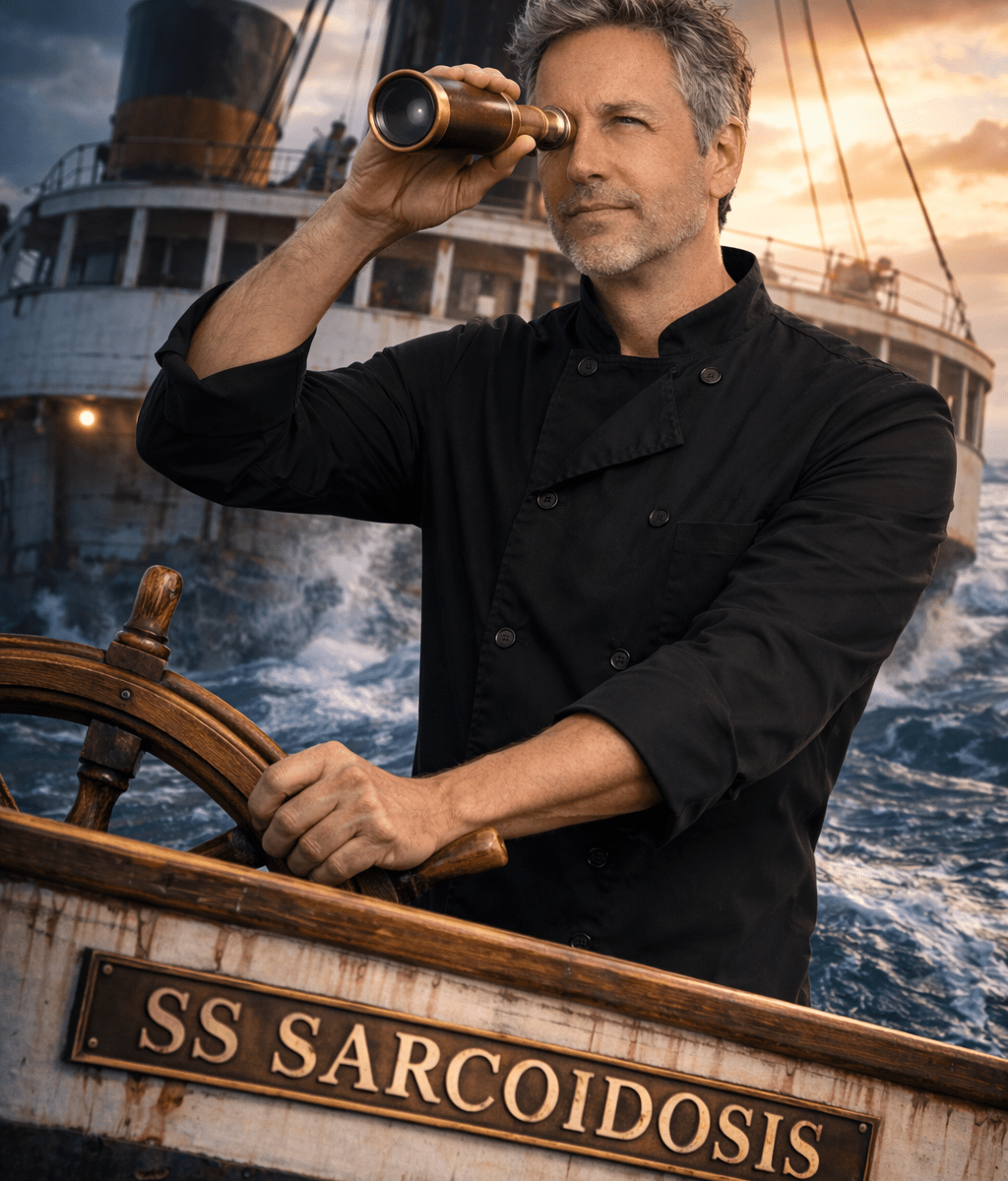
I’m “positive” the way a chef is “positive” the stove is still on: I’m aware of the danger, I’m monitoring it constantly, and I’m doing what I can to keep the whole place from going up in flames.
Because if we’re going to talk about pretense, let’s talk about the pretense that you can only survive chronic illness one way: by being perpetually furious and miserable like it’s a required uniform.
I understand the temptation. I do. Some days, misery feels like the only honest reaction. And if you’re in that place—if your body is hurting, your energy is gone, your brain is fogged up like a steamed mirror, and you’re staring at yet another appointment reminder thinking, “Fantastic, another day of being medically perceived”—I get it.
But let me show you the actual kitchen I’m working with.
I’ve got sarcoidosis. That’s the headliner. The star of the show. The one that shows up uninvited and then acts like it pays rent.
I’ve got heart failure. Yes, that’s real. Yes, it arrived early. No, it did not send a courtesy email first.
I’ve got osteoporosis, courtesy of prednisone—because if you’re going to treat one problem, why not throw in a bonus sequel?
I’ve got a partially paralyzed diaphragm (left side, if you’re curious). My body really said, “What if breathing… but with less enthusiasm?”
I’ve got an acoustic neuroma, which is a benign brain tumor, for anyone who didn’t wake up today hoping to learn new medical vocabulary. It’s benign, sure—like a “friendly” bear. Still a bear. Still not what you want in your living room.
And I’ve got prednisone-induced diabetes, because of course I do. You can’t make this stuff up. If I wrote it in a novel, my editor would send it back with a note that says, “Too much. Tone it down. Nobody will believe this.”
That’s not even counting the magical reversal of pulmonary hypertension that still has my doctors staring at my charts like they’re trying to solve a cold case. Either the universe glitched, or somebody accidentally filed the wrong paperwork.
I’ve had spontaneous lung collapses.
Hospital stays.
And I’ve collected enough pill bottles to construct a luxury condo tower for my dog’s chew toys, complete with amenities and a doorman.
I also have an implanted defibrillator. An AICD. And I want to take a moment to crush a popular cinematic fantasy: it does not beep ominously every time I have an emotional moment. There is no dramatic little warning chirp when I watch a sad commercial. It does not flash “FEELINGS DETECTED” like a security system.
It only pings when the battery is dying.
So if anyone hears beeping in my general vicinity, please don’t whisper, “Is this it?” Just stand back and let me call Boston Scientific like a normal person with a malfunctioning chest appliance.
This is my life. This is the roster. This is the ongoing reality show in my body, starring inflammation and surprise plot twists.
So when someone implies I’m faking positivity, like I’m a deranged Instagram guru selling avocado spiritual retreats and a downloadable workbook called “Breathe Your Way Into a New You,” I understand why it hits a nerve.
It’s irritating. It’s dismissive. And it assumes optimism is either ignorance or performance.
But here’s the part people miss: humor and hope aren’t a denial of pain. They’re how I live with it.
They’re tools. They’re strategies. They’re the emotional equivalent of keeping a fire extinguisher near the stove.
Because I absolutely have days when the symptoms stack up like a poorly insulated sandwich and all I want to do is fling metaphorical plates into the void.
There are days when my body feels like it’s arguing with itself in every room at once. When fatigue hits like someone unplugged my power cord. When pain shows up with no warning, like a rude guest who doesn’t knock and then complains about the seating.
There are days when I’m so tired I don’t even have the energy to be dramatic about it. I just sit there, blinking slowly, like a malfunctioning appliance.
And yes, there are days I’m angry. Angry at my body. Angry at the randomness of it. Angry at the way chronic illness steals time and then charges you interest.
But I need to say this clearly, because it matters:
I am not obligated to make my suffering my entire personality.
I am not required to wear misery like a name tag so other people feel validated.
I am not here to audition for the role of “tragic chronic illness mascot” so strangers can point at me and say, “See? That’s the correct amount of despair.”
I don’t owe anyone constant gloom.
I owe myself survival.
And survival, for me, looks like refusing to let chronic illness be the only narrator in the room.
That doesn’t mean I’m pretending.
It means I’m choosing—daily, sometimes hourly—how much airtime I give the worst parts of my reality.
Because life does give us choices. Not in the “just visualize your way out of illness” way. That’s nonsense. Nobody visualizes their diaphragm into working again. Nobody meditates a tumor into disappearing. Nobody manifests new bone density by journaling under a full moon.
But I can choose how I respond to what’s happening inside my body.
I can choose whether I speak to myself with kindness or cruelty.
I can choose whether I let bitterness be the default seasoning on every moment.
I can choose whether I treat my own life like it’s already over, or like it’s still mine.
This is where the satire comes in, because our culture has two deeply annoying and equally unrealistic storylines for chronic illness:
Option A: You are a brave inspirational saint who never complains, floats through adversity on a cloud of gratitude, and somehow always looks like you just stepped out of a wellness catalog.
Option B: You are a tragic cautionary tale who exists solely to warn others, punish yourself for having feelings, and confirm everybody’s worst fears about what it means to be sick.
Both options are garbage.
Both options flatten a real person into a character.
And neither option leaves room for the truth, which is messier and more human:
Sometimes I’m hopeful.
Sometimes I’m furious.
Sometimes I laugh.
Sometimes I cry.
Sometimes I do both at the same time, which is a very awkward experience and not one I recommend.
Sometimes I make jokes because if I don’t, I’ll scream.
Sometimes I’m optimistic because it’s literally the only thing that keeps me from mentally collapsing in on myself like a folding chair.
Optimism is not a personality trait I was born with. It’s a coping mechanism I built.
It’s a raft.
It doesn’t make sarcoidosis disappear. It doesn’t rewrite my medical chart. It doesn’t cancel appointments or refill my energy meter.
It just keeps me afloat.
And before someone rushes in to say, “But positivity can be toxic”—yes. Absolutely. Toxic positivity is real. That’s the version where people tell you to smile through suffering like your pain is an inconvenience to their vibe.
That’s the version where someone says, “Everything happens for a reason,” and you want to gently place them into the nearest recycling bin.
That’s not what I’m talking about.
What I’m talking about is the kind of positivity that isn’t about pretending you’re fine.
It’s about refusing to let illness have the microphone every single day.
It’s about saying: “This is hard, and I’m still here.”
It’s about cracking a joke between breaths, even if that laugh sounds raspy because one side of your diaphragm decided it’s on a permanent lunch break.
It’s about finding something—anything—that makes the day feel less like a punishment.
And if that’s not your way? If you’re not there yet? If you’re reading this from your own version of the deep end? I’m not judging you. I’m not handing out gold stars for coping styles.
Some days, survival is lying still and making it to the next hour.
Some days, survival is getting through a meal.
Some days, survival is taking your meds and not throwing the bottle across the room like a tiny plastic insult.
But what I won’t accept is someone telling me that because they’re drowning, everyone else has to stop swimming.
So yes, dear commenter, you are entirely free to be a sad, angry, suffering fool. No judgment. Truly. If that’s where you are right now, it’s valid.
But don’t drag the rest of us under the waves because you’re convinced there’s no other way.
Some of us are kicking and flailing and accidentally swallowing saltwater while trying to reach the metaphorical shore. And that may look ridiculous—because it is ridiculous, sometimes—but at least we’re trying.
And trying matters.
Because chronic illness has a way of shrinking your world. It takes your plans, your stamina, your certainty, and sometimes even your identity, and it hands you a smaller life with a bigger instruction manual.
It tries to convince you the future is pointless.
It tries to make you forget who you were before the diagnoses.
It tries to make you think the only honest emotion is despair.
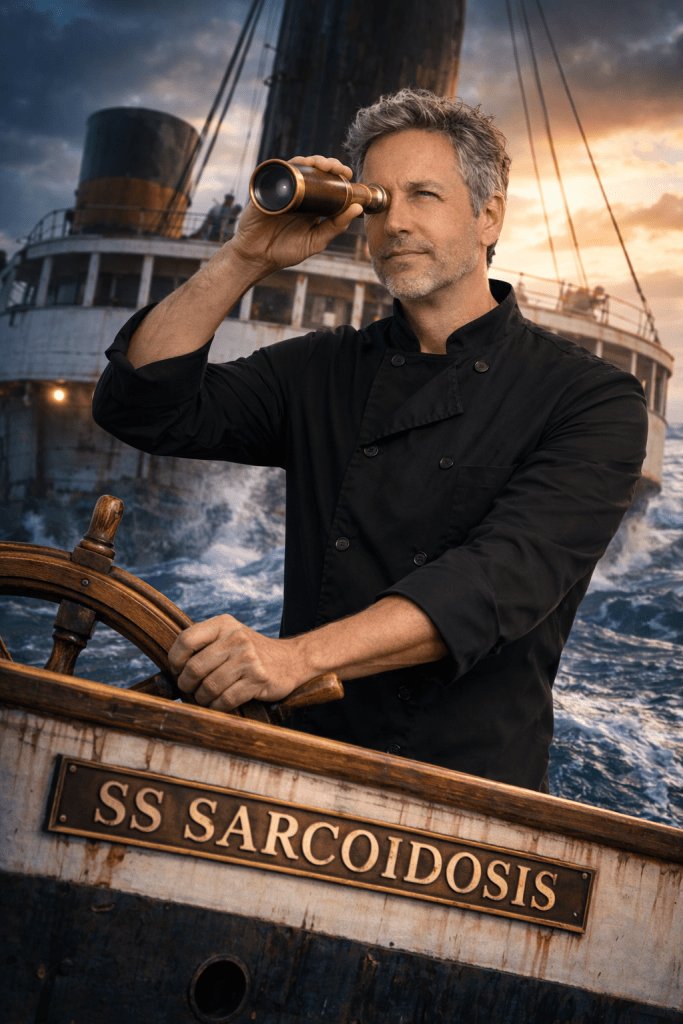
But I’m a chef. And chef brain is not built for surrender.
Chef brain is built for improvising when the oven dies mid-service.
Chef brain is built for making something edible out of what’s left in the pantry.
Chef brain is built for continuing, even when the conditions are absurd.
So I do what I do in the kitchen: I adapt. I adjust. I season as I go.
And yes, I crack jokes, because sometimes humor is the only seasoning that cuts through the bitterness.
There’s another layer to this too, something that doesn’t get said enough in chronic illness spaces:
When you’re sick for a long time, people start policing your emotions.
If you’re too sad, they’re uncomfortable.
If you’re too honest, they disappear.
If you’re too hopeful, they accuse you of pretending.
It’s like there’s no acceptable way to feel unless it makes other people feel better about your situation.
So let me offer this as a permission slip you didn’t ask for but might need:
You get to feel what you feel.
You get to change your mind.
You get to have a good day and not apologize for it.
You get to laugh and not feel guilty.
You get to be hopeful and still be sick.
Hope is not denial. Hope is endurance.
Hope is a muscle. And like any muscle, it gets built through repetition. Through small moments. Through stubborn little decisions that say, “Not today,” even when today is trying you.
If you’re reading this and you’ve got your own chronic illness to navigate—sarcoidosis, diabetes, neuropathy, autoimmune nonsense, the whole parade—I see you.
If you’re furious, I see you.
If you’re exhausted, I see you.
If you’re trying to stay afloat with duct tape and sarcasm, I see you.
And if you’d like to swim alongside someone who’s sarcastic, stubborn, and weirdly committed to finding a sliver of light even when the body is being dramatic? You’re welcome here.
Because the truth is, I may not make it to shore.
None of us gets a guarantee.
But I’ll whistle while I swim.
I’ll enjoy the scenery when I can—even if the scenery is just my dog staring at me like I’m personally responsible for the laws of physics.
I’ll make jokes, not because I’m unaware of the pain, but because I refuse to let it be the only language I speak.
And if that bothers someone? If my refusal to be permanently miserable feels like “pretense”?
They can take it up with the bluebirds.
They’re busy. They’re making my bed.
So… got thoughts, feelings, or snark of your own? Drop them in the comments. Tell me how you stay afloat. Tell me what helps. Tell me what doesn’t. And if you want more chronic illness real talk with a side of humor, subscribe so we can keep cheering each other forward.
Discover more from Tate Basildon
Subscribe to get the latest posts sent to your email.
 Tate Basildon