

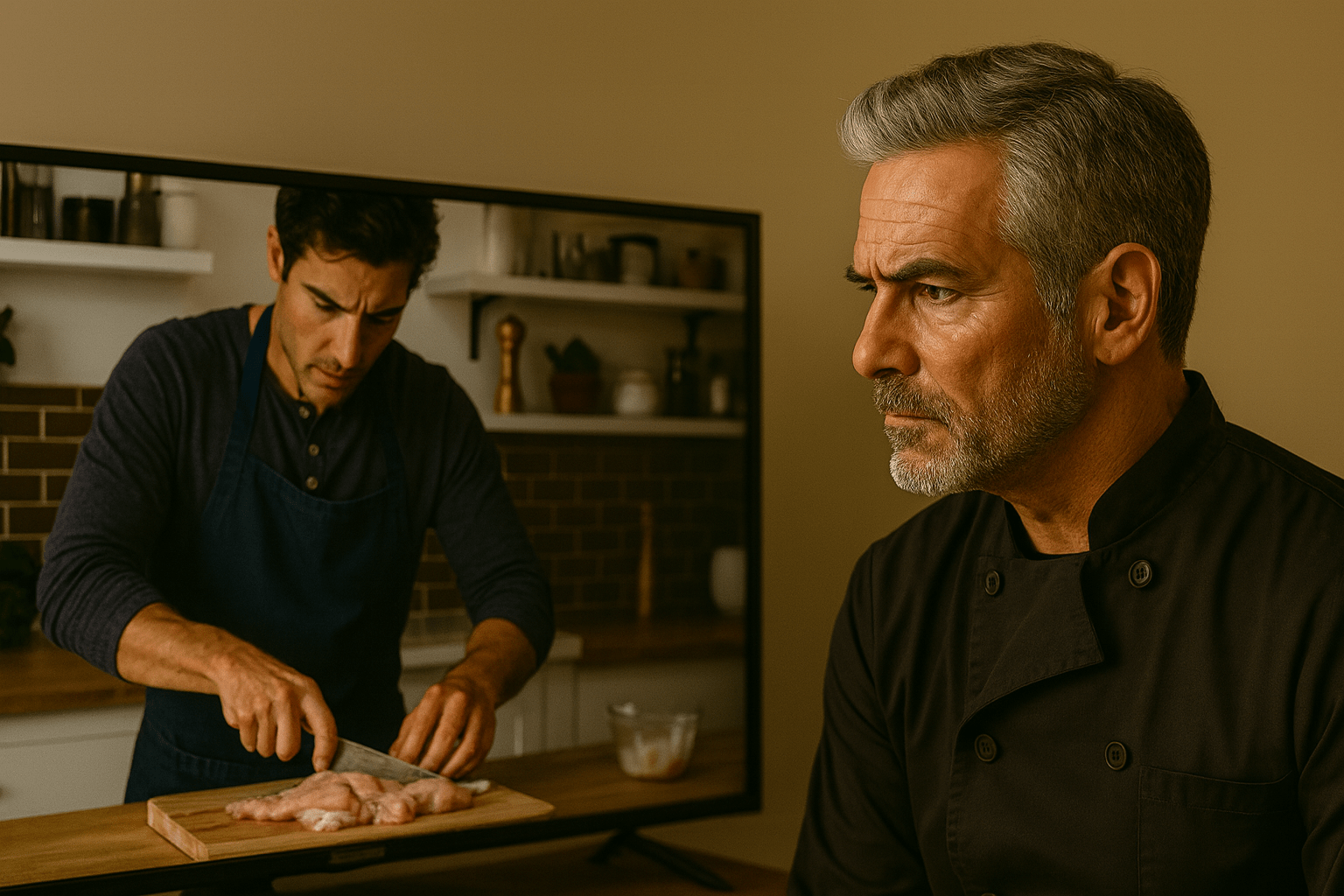
Let me start with a confession that could get me banished from some culinary circle somewhere: I hate cooking shows. Yes, I know—coming from a private chef who’s spent years elbow-deep in both five-star meals and home-cooked comfort food, it sounds like sacrilege. But someone has to say it, and it might as well be me, because the truth is simmering in my soul like an over-reduced stock: cooking shows are bad for your health, your confidence, and occasionally your dinner.
When people hear I’m a chef, the first thing they ask—after “Do you cook at home?” and “What’s your favorite knife?”—is whether I watch all those cooking programs. You know the ones. The shows where the chef-host glides through a spotless kitchen in a perfectly pressed apron, hair styled by someone who’s never seen a walk-in freezer. I’m convinced half of these kitchens don’t even turn on the stovetop—it’s all glow and no heat.
Let me tell you something: I avoid cooking shows the way responsible adults avoid expired shellfish.
But the real reason I brace myself when I accidentally catch one? The blatant disregard for food safety. It causes a twitch in my eye that rivals the one I get when my oxygen concentrator beeps unexpectedly. And trust me, when you live with sarcoidosis and heart failure, you don’t have patience—or heartbeats—to spare.
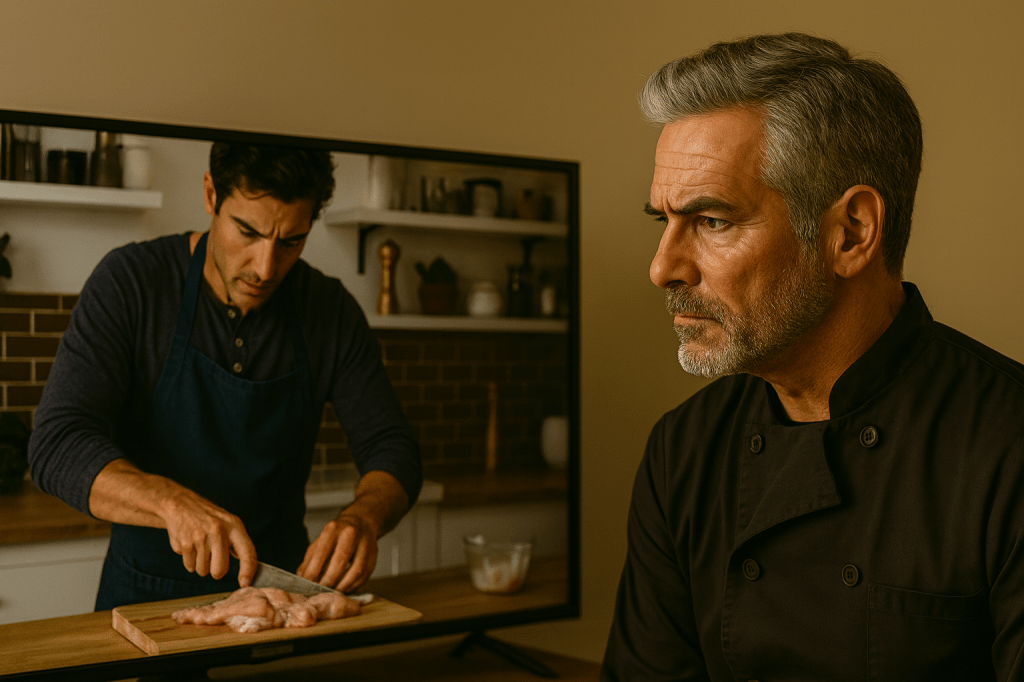
I once watched a cooking show host handle raw chicken, wipe his hands on a dish towel, then immediately start chopping herbs with those same salmonella-soaked fingers. At one point he touched his face. I nearly passed out, and not for medical reasons for once. If you want a real thrill, forget horror movies—just watch someone smear raw chicken residue all over their cutting board without a hint of remorse. It’s culinary trauma.
You’d think the network would cut the camera and yell, “Stop! Grab a Clorox wipe!” But no, everyone smiles like they didn’t just set up half the viewing audience for a gastrointestinal nightmare.
I’m convinced we should replace the dramatic music in these shows with a countdown clock—the audience can shout “He touched the lettuce! Nooooo!” the same way people yell during football games. Except instead of touchdowns, we’re tracking cross-contamination. Riveting stuff.
But food safety isn’t the only reason these shows make me want to fling a sauté pan out a window. Oh no. There’s also the ingredient lists that read like a scavenger hunt put together by overly enthusiastic elves.
You know the ones. The host beams at the camera and promises a “simple weeknight dinner” that requires preserved lemon, black garlic, foraged mushrooms, saffron threads, fennel pollen, and an herb that only grows on misty cliffs in the Himalayas. Meanwhile, the rest of us are at home wondering if we can pull together dinner with what’s left in the fridge—usually a half-wilted bag of spinach and the last two eggs.
And don’t get me started on the finishing salts. Why do we need three? We barely needed one. The chicken certainly didn’t. But TV chefs have to season everything like they’re casting a spell, because apparently the camera eats first.
I once saw a dish with so many ingredients that the chicken might as well have been a background extra. The poor bird was buried under herbs, infused oils, crunchy things, tangy things, and a garnish that looked like it belonged in an art gallery. At some point, we lost the plot—and the protein.
The heart of good cooking is restraint. Knowing when NOT to add another ingredient just because it photographs well. Knowing when the chicken should be allowed to taste like—brace yourself—actual chicken. But restraint doesn’t pull ratings, so we get dishes that look like they came out of a Warhol exhibit instead of a kitchen.
And while we’re talking theatrics, the biggest performance of all is the way cooking shows manipulate what cooking looks like. Not a single stovetop is ever dirty. Nobody sweats. Nobody looks confused about where someone moved the tongs. Meanwhile, in my kitchen, real life includes sticky countertops, misplaced spoons, and the occasional moment where I yell “Who took my spatula?!” into the void like I’m summoning spirits.
Real cooking has sound effects: sizzling oil, clattering pans, dogs barking, husbands asking if we have any more of that pesto from last week, and oxygen concentrators softly wheezing in the background like a sleepy robot. It’s messy, unpredictable, and occasionally chaotic—but there’s heart in it. There’s intention. There’s love.
But the polished fantasy of cooking shows? Zero relatability. Zero authenticity. Zero chance the host actually did the prep work themselves.
It’s all one big performance. And maybe that’s fine if you’re watching for entertainment. But the problem is people believe it. They start thinking they should be able to magically cook a flawless meal without dirty dishes, kitchen timers, or culinary panic. They start doubting their own instincts. They start thinking they’re supposed to enjoy every minute of making dinner.
Let me be very clear: even professional chefs do not enjoy every minute of making dinner.
We love food. We love feeding people. We do not love burning our fingertips, realizing we forgot the scallions, or discovering we’re out of parchment paper at the exact moment it matters most.
So what do I watch? Mostly, nothing. I cook. I write. I podcast. I wrangle dogs. I breathe through all the medical nonsense that comes with sarcoidosis. Cooking shows don’t inspire me—they set off my internal alarm system.
On the rare occasion I catch one accidentally, I spend the entire episode yelling at the screen like an uncle watching a bad football call. “No! Don’t use the whisk you just dipped in raw eggs! Stop! Where is your thermometer?!” My dog looks at me like I’m unwell. Which, technically, is fair.
Call me old school. Call me dramatic. Call me the kind of guy who wants his dinner cooked by someone who understands what an actual foodborne illness looks like. Just don’t call me for dinner if your culinary education comes from a show where the chef handles raw chicken and then touches their face. I’m not risking it. I’ve already got sarcoidosis; I’m not adding salmonella to the list.
The truth is, I want cooking to feel accessible. I want people to feel empowered. I want you to know you’re not supposed to pull off a “simple 20-minute meal” that involves six cutting boards and a smoke machine. You’re supposed to feed yourself. That’s it. No camera angles required.
If your dish doesn’t look Instagram-ready, congratulations—you’re officially cooking like a real human being.
And if you’ve ever yelled at a cooking show too, welcome to the club. We meet on Tuesdays and complain about the irresponsible use of fresh herbs.
Now, tell me—what cooking show moment made YOU question humanity?
Have you ever yelled at a cooking show, or sworn off a recipe because it required ingredients that sounded like they came from a wizard’s pantry? I’d love to hear your stories. Drop a comment below, and if you enjoy my blend of chronic illness honesty, kitchen wisdom, and sarcastic chef muttering, hit subscribe so you never miss a post.
Discover more from Tate Basildon
Subscribe to get the latest posts sent to your email.
 Tate Basildon
My husband was a chef but he and I absolutely love shows such as Tournament of Champions, 24 in 24, and Diners,Drive-ins, & Dives. I have learned so much on how to use different ingredients in my typical recipes to elevate the dish. (Yes, I do most of the cooking) However, I agree with you about cross-contamination. My husband will handle cooked food and wipe his hands on my clean dish towel instead of washing his hands first. Ugh! It makes me want to pull my hair out especially when he’s handling a whole raw chicken. So, I pick up all of the towels when he’s finished in the kitchen and throw them on the washing machine and get fresh ones. When I first met him in a restaurant we worked together in, the cooks would have buckets of bleach water for their cleaning towels. Maybe that’s where his habit started with using my dry towels for his hands. Haha!
LikeLiked by 1 person
Oh yeah, that habit definitely comes from kitchen training. I hadn’t stepped foot in a real restaurant kitchen before culinary school, but they hammered sanitation into us like our lives depended on it—because, well, sometimes they do. My internship was at a restaurant run entirely by CIA grads, so the standards were spotless—literally. Then one night I helped out a caterer… and wow. No one had formal training, and the hygiene situation was straight out of a kitchen nightmare. I was mentally Clorox-wiping everything in sight. Honestly, good sanitation comes down to training. When I worked for Marriott, their protocols were next level. Like, “hazmat suit chic” levels of clean.
LikeLike