


In May of 2006, I started taking prednisone, and like the world’s worst houseguest, it never left.
You know the type. Shows up uninvited. Eats all your snacks. Rearranges your furniture. Then somehow convinces everyone it’s doing you a favor by “helping around the place.” Prednisone is that guy, except instead of moving your couch two inches to the left, it moves your entire endocrine system into a back alley and steals its wallet.
I tried kicking prednisone out a few times over the years. I really did. But here’s the thing about long-term steroid use: at some point, your body gets so used to the external cortisol supply that it stops making its own. Which is a very rude way for your adrenal glands to say, “We’ve decided to retire early. Good luck, though.”
So now, nearly twenty years later, I’m still swallowing between five and ten milligrams a day. Not because I’m nostalgic for the taste of bitter chalk, but because it helps keep me alive. And I do enjoy being alive, even when it comes with add-ons I didn’t order.
This is the part where I remind you I’m living with sarcoidosis and heart failure, and I’ve been at this for long enough to know that “side effects” is often just polite marketing language for “we’re going to change your life in ways you don’t get a vote on.”
At first, prednisone felt like the answer. It reduced inflammation. It helped me breathe. It helped me function. It helped me keep moving forward when my body had other plans. But while it was keeping me upright, it was also quietly sabotaging me in the background like a passive-aggressive coworker who smiles at you in meetings and then deletes your files.
One of the slow-burn betrayals was my A1C.
For years, my A1C was normal—solidly in the fives. And for anyone not living in lab-value land, A1C is basically your three-month blood sugar report card. A “how have you been behaving?” score. A “do we need to have a talk?” number.
Mine started creeping up. Not dramatically. Not in a way where alarms go off and someone tackles you in the waiting room. More like… a slow drift. A few tenths here. A few tenths there. Until it wasn’t a drift anymore, it was a trend.
In January, I hit 6.3. One tick away from diabetes. The medical version of standing at the edge of a cliff while your doctor squints at you and says, “So… are you planning to jump or just lean forward a bit?”
By June, I hit 6.4. And there it was. Stamped in my chart. Diabetic.
Now, look. I’m a chef. My life has revolved around food, flavor, hospitality, and feeding people in ways that make them feel cared for. I’m not new to nutrition. I’m not allergic to vegetables. I’m not out here chugging soda like it’s communion wine.
But prednisone doesn’t care about your culinary degree or your intentions. Prednisone is not impressed by your roasted Brussels sprouts. Prednisone is like, “That’s adorable. I’m going to spike your glucose anyway.”
So naturally, I decided to get serious about tracking my blood sugar.
And by “serious,” I mean: I wanted data without suffering.
Because multiple finger sticks every day? Hard pass.
I have enough things poking me, monitoring me, scanning me, interrogating me, and reminding me that my body is an unreliable narrator. If I have to add “stab my fingertips repeatedly like I’m auditioning for a vampire documentary” to the routine, I’m going to start bargaining with the universe in ways that get very dramatic, very fast.
So I did what modern people do when faced with inconvenience: I bought a gadget.
A continuous glucose monitor. A CGM. The promise was simple: effortless numbers on my phone, zero lancets, and a better understanding of what food was doing inside my body. I would wear this tiny sensor, check my glucose whenever I wanted, and glide into improved health like some sort of responsible adult who has it together.
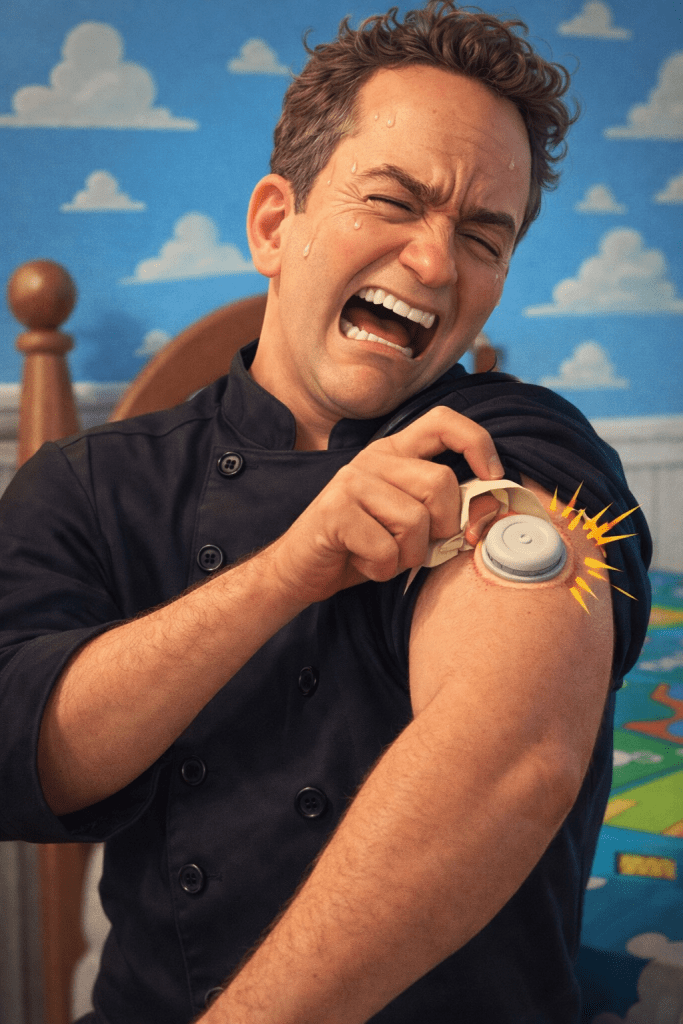
The first time I stuck it into my arm, I genuinely thought I had found freedom.
For about two days.
Then it started to feel like I’d jammed a thumbtack into my muscle and left it there as a personal challenge. Every time I flexed my arm, I got this sharp zing that said, “Hi. I’m your new accessory. I hurt, and I’m not leaving.”
I tried to ignore it. I’m very practiced at ignoring discomfort. Chronic illness teaches you that. You become a professional negotiator with pain. You learn how to move around it, work with it, tolerate it, pretend it isn’t happening when you’re trying to be normal.
But this wasn’t background pain. This was a steady little reminder that something sharp was living in my arm rent-free.
And then, after five days, it quit.
Just… stopped.
It wasn’t a dramatic failure with sparks and sirens. It simply gave up like a bored employee two hours into a shift. My app flashed that it was done. No more readings. Goodbye.
Customer service was lovely, I’ll give them that. They mailed me a replacement. They were polite. Efficient. Sympathetic in that very corporate way where you can tell they’ve been trained to sound like they care while also thinking about their lunch.
But the honeymoon was over.
I tried again, this time on the other arm. It wasn’t quite as torturous, but it still wasn’t comfortable. And let’s be real: when you’re already managing sarcoidosis and heart failure, your tolerance for “optional discomfort” gets real low. I am not collecting pain like it’s a hobby. I’m not building a museum exhibit called “Sensations I Didn’t Ask For.”
Eventually, my endocrinologist suggested the belly.
Apparently, the belly has more fat, more cushion, and less chance of me feeling like I’ve stapled myself. The belly is supposed to be the friendly neighborhood of CGM placements. Warm. Welcoming. Soft landing.
So I tried the belly, and it actually worked better.
Until the day I managed to hit something. Nerve. Muscle. A demon. A portal. I don’t know what it was, but I do know the pain was immediate and intense, like my body was yelling, “Absolutely not. Remove that. Now.”
And I did. I yanked it out.
Which is a very fun moment because these things are one-time use. There’s no “oops, let me reposition.” There’s no “can we just try again a centimeter over?” Once it’s in and it’s wrong, congratulations—you’ve just thrown money in the trash.
At the time, I figured I’d basically tossed forty-five bucks straight into oblivion. And honestly, I’ve made worse purchases in moments of desperation. But I was still annoyed because I wanted this to work. I needed it to work.
The goal was simple: three months of data to help lower my A1C.
I wanted to see patterns. I wanted to understand what was spiking me and what wasn’t. I wanted to make changes that actually mattered, not just vague lifestyle suggestions like “have you tried being less sick?”
And the CGM did give me data.
A lot of it.
It showed me a steady stream of numbers that felt reassuring. It gave me graphs. Trends. A neat little narrative about my body. It made me feel like I was finally holding the steering wheel.
At one point, the app proudly flashed a projected A1C of 6.2 with an average glucose of 120. It looked like progress. It looked like I was winning. It looked like I had finally cracked the code.
I got so proud I practically strutted into Quest Diagnostics. I was humming with that rare feeling of “maybe I’m doing this right.” I sat down, rolled up my sleeve, gave them my blood like a responsible citizen, and went home feeling hopeful.
Then the lab result came back: 6.5.
Six point five.
Diabetes, confirmed. Again. With emphasis.
And suddenly, the CGM’s cheerful little 6.2 projection felt like being told by someone, “You look amazing,” while you have spinach in your teeth and your fly is down.
The CGM wasn’t just off by a couple points. It was off by twenty.
Twenty.
That’s not a rounding error. That’s not “close enough.” That’s the difference between patting yourself on the back and having a medical chart that says, in black and white, “Welcome to the club you didn’t want to join.”
And yes, I know A1C and CGM estimates aren’t always identical. I’m not asking for perfection. I’m not expecting my phone to be God. But twenty points? That’s not a minor mismatch—that’s a full-on identity crisis.
It left me with the one thing you don’t want when you’re managing a chronic illness: doubt.
Because here’s what chronic illness already does: it makes you second-guess your body. Every symptom becomes a puzzle. Every ache could be something or nothing. Every day is a little negotiation with energy, breath, heart rate, fatigue, medications, side effects, and whatever new surprise your immune system cooked up overnight.
You learn to trust certain things because you have to. You trust your meds, even when they annoy you. You trust your doctors, mostly. You trust the lab results, usually. You trust the systems you can measure, because when you’re sick, measurement feels like control.
So when your CGM gives you pretty data and then reality shows up and says, “Actually… no,” it’s not just frustrating. It’s destabilizing.
That said—because I’m not here to throw the whole thing into the sea—using the CGM did teach me a lot.
For one: potatoes are my mortal enemy.
I’m not happy about it either. Potatoes are comfort. Potatoes are home. Potatoes are the culinary equivalent of a warm hug. Potatoes are also apparently tiny glucose grenades in my body.
Bread, surprisingly, didn’t hit me as hard as I expected. Which felt unfair in a different direction, because bread has been blamed for everything since the beginning of time. Meanwhile, potatoes are out here acting innocent with their wholesome farmer’s market vibe, and then they launch my glucose into orbit.
The CGM showed me what sent me skyrocketing and what barely moved the needle. It made me pay attention in a way I hadn’t before. It made the invisible visible.
And that part was valuable.
But the problem is trust.
If I have to finger stick to double-check the CGM, what is the point of strapping a pricey sensor to my body every month?
If I have to treat the CGM like a suspicious coworker who “forgot” to mention a crucial detail, then it’s not a tool—it’s a stressor. It’s another thing to manage, another thing to question, another thing that makes me feel like I’m doing the work and still not getting the truth.
These sensors aren’t cheap. If I’m paying around $90 a month for something that may or may not be accurate for me, I start doing the math like a chef looking at a menu price and thinking, “For that money, I could make it better at home.”
For the cost of one sensor, I could walk into Quest Diagnostics every six weeks, hand them forty-five bucks, and get an A1C I can actually believe.
Insurance only covers it twice a year, because of course it does. Because why would insurance support frequent monitoring for something that could prevent complications when we can just wait until things are worse and then act surprised?
But if the choice is paying out of pocket for truth versus paying out of pocket for a device that gives me confidence I can’t rely on, I’m choosing truth.
Because the stakes aren’t theoretical. Diabetes isn’t just a label. It’s a risk layer. It’s a multiplier. It’s a “now we also have to think about eyes, kidneys, nerves, circulation, healing, infection risk,” and when you already live immunosuppressed and medically complicated, you don’t need extra risk. You need fewer surprises.
And yes, before anyone says it: I know managing blood sugar is more than A1C. I know daily patterns matter. I know post-meal spikes matter. I know the CGM gives real-time insights that labs don’t.
But I also know what it feels like to be gaslit by a graph.
I know what it feels like to do everything right and still get a number that says otherwise. And I know how much energy it takes to stay engaged in your own care when your tools aren’t reliable.
So here I am. Officially diabetic. Thanks to my lifelong romance with prednisone. Still juggling sarcoidosis, heart failure, and now this new layer of fun. Because why have one complicated thing when you can collect them like limited-edition action figures?
But I’m also not helpless.
I’ve been here before—in different versions. When you live with chronic illness, you learn something the hard way: you can’t always control what happens to you, but you can control how you respond. You can control the way you adapt. The way you problem-solve. The way you refuse to let your life shrink to the size of your diagnosis.
So I’m doing what I can do.
I’m making better food choices, not perfect ones. I’m choosing meals that don’t punish me later. I’m paying attention to how different foods hit me, not just in theory but in my actual body. I’m moving when I can, in ways my heart and lungs will tolerate. I’m letting “exercise” mean “a little more movement than yesterday” instead of “punish myself until I’m broken.”
And I’m getting lab work that doesn’t lie to me with a smile.
Because survival with chronic illness is not about doing everything flawlessly. It’s about being stubbornly creative. It’s about building a life with the body you have, not the body you wish you had. It’s about getting good at adjusting the recipe when the ingredients change without asking.
Prednisone may have kept me alive, and I’m grateful for that, even when I want to throw the bottle into the sun. Sarcoidosis may still be doing whatever it feels like. My heart may still have its own opinions. My A1C may still inch up and down like it’s trying to annoy me on purpose.
But I’m still here.
And I’m still choosing how I respond.
Right now, that response is equal parts grit, gallows humor, and just enough sarcasm to keep my spirit intact. Because if I can’t laugh at the absurdity of all this sometimes, then what am I supposed to do—cry into a potato?
If you’ve used a CGM, did it feel accurate for you? Did it help you make changes, or did it make you want to argue with your phone? Are you team CGM, team finger-stick, or team “I trust the lab and that’s it”? Tell me what your experience has been in the comments—and if you haven’t already, subscribe so you don’t miss future posts where we keep trading survival strategies and dark little laughs from the chronic illness trenches.
Discover more from Tate Basildon
Subscribe to get the latest posts sent to your email.
 Tate Basildon