

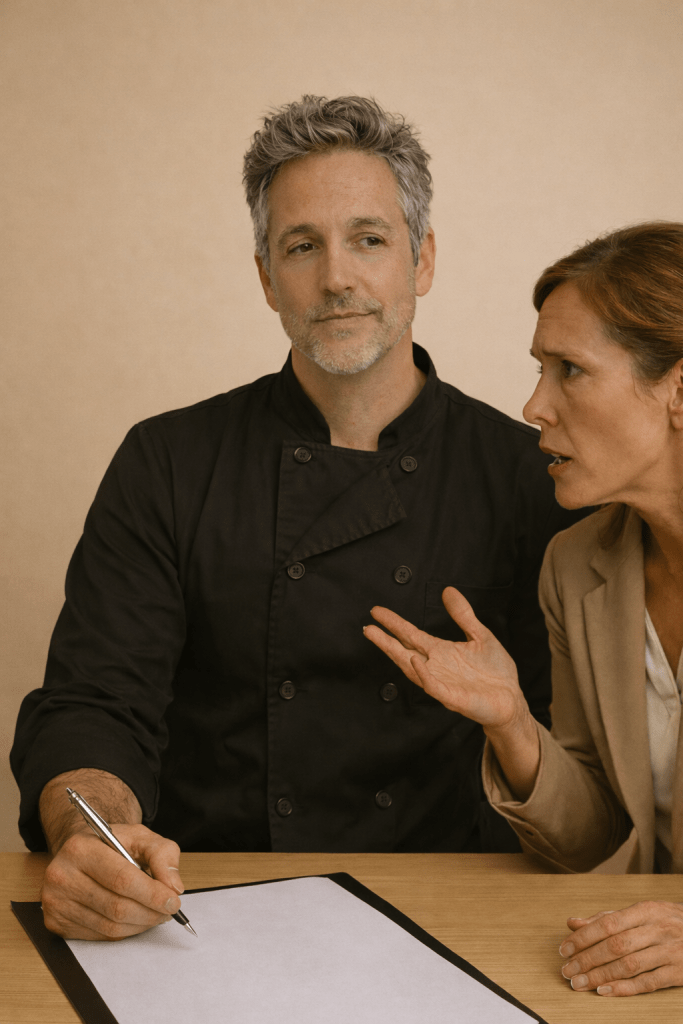
Recently—because my life can never resist throwing in a plot twist—I was invited to participate in a study for people who’d had strokes or TIAs. Since I picked up a TIA back in 2007 like a surprise party I didn’t ask for, I qualified. And because I’m me, still someone who says yes to medically-adjacent nonsense before fully thinking it through, I showed up bright-eyed, bushy-tailed, and ready to be weighed, poked, measured, and judged by a brand-new set of strangers in scrubs.
The opening act was routine: height, weight, blood pressure, blood draw. If they’d measured how many internal sighs I had, they’d need a bigger chart. But then came the main event—an hour-long survey that felt like somebody hired a committee of gloomy poets to write every question after binge-watching tragic documentaries. I expected general health stuff. They expected me to be dangling over an emotional cliff. Somewhere in the middle stood me, the survey-taker, and my last good nerve, hanging on like a cat on a motivational poster.
Every question dug for emotional devastation. Depression? Check. Despair? Obviously. Worthlessness? Naturally. Suicidal thoughts? Must ask—multiple times, just in case I changed my mind in the past thirty seconds. It was like being interrogated by someone who desperately needed me to crumble so their data would line up neatly. Meanwhile, I was just trying to remember if I left the dogs enough snacks and whether I could squeeze in a nap afterward.
But somewhere around question forty-seven—right after “When did you last feel hopeful?”—it hit me: so many people do carry darkness with them while managing chronic illness. The survey wasn’t ridiculous for asking. It was heartbreaking that so many people struggle deeply, silently. And suddenly I felt grateful—grateful for whatever crooked combination of perspective, stubbornness, and sarcasm keeps me afloat.
Then came the question asking how negatively my TIA had affected my life. I checked “none.” The survey-taker froze. Blinked. Tilted her head like a confused golden retriever. “There’s no option for that,” she said gently.
Which, frankly, sounded like a challenge.
So I explained: My TIA was the blessing disguised as a disaster. If it hadn’t happened, we never would’ve discovered the heart failure lurking quietly in the background. That chain reaction—annoying, terrifying, and wildly inconvenient—also saved my life. The TIA didn’t ruin things; it redirected them. Hard, yes. Unexpected, absolutely. But it shoved me toward diagnoses and interventions that kept me above ground. The universe sometimes gives warnings in the form of medical chaos.
The poor woman looked stunned. “There’s no option for that answer,” she repeated.
And that’s when the bigger truth smacked me in the face: the medical system assumes chronic illness is synonymous with despair. It expects us to be angry, broken, hopeless, and emotionally unraveling. And honestly, many people are. And why wouldn’t they be? We hand out pills for every one of those feelings like Halloween candy.
But where was the checkbox for gratitude? For acceptance? For “I’m annoyed, exhausted, sarcastic, and still showing up”? Where was the option that said, “This awful thing ended up saving me”?
It didn’t exist. And ironically, that absence told me more about the state of healthcare than any question on the page.
Not all of us are walking tragedies. Some of us are just tired, heavily caffeinated chronic-illness veterans trying to live our lives without falling into an emotional sinkhole every time a new lab result arrives. Chronic illness doesn’t erase joy—it just complicates the journey to it.
Looking back on that survey—even though it was just recent—it felt like a reminder of how far my mindset has carried me. The hard parts don’t vanish, but they don’t own me either. I didn’t fit into their checkbox because I’ve rewritten the script on how I respond to the chaos.
And honestly? For a free blood draw, that revelation wasn’t a bad return on investment.
If you’ve ever taken a medical survey that completely missed who you are, share your experience in the comments. And if you enjoy these reflections on chronic illness, resilience, and the occasional sarcastic meltdown, subscribe so you never miss a post. Let’s navigate this wild chronic-illness life together.
Discover more from Tate Basildon
Subscribe to get the latest posts sent to your email.
 Tate Basildon